
.png)
VC is a powerful tool, but not a milestone.
Most founders who pursue VC prematurely fail because the VC model is structurally incompatible with the stage, market, or ownership goals they actually have. And the ecosystem's obsession with fundraising announcements actively obscures that incompatibility.
.png?width=1620&height=1620&name=VC%20IS%20NOT%20FOR%20EVERYONE%20(V%C3%ADdeo%20para%20Facebook).png)
What Happens When Founders Raise Too Early
A founder closes a $2M seed round. Within six months, she has hired a team of eight, signed a lease, and started running paid acquisition in a market she hasn't fully validated. Twelve months later, the money is almost gone. Revenue is flat. Her investors are asking for traction she cannot show, and she is now trapped: too far along to pivot cheaply, too early to raise again credibly, and carrying a cap table that prices out the kind of patient capital she actually needed.
This is not an edge case. It is one of the most common failure patterns in early-stage startups, not a failure of execution, but a failure of instrument selection. The founder's business was real. Her market was real. What was wrong was the capital structure she chose, and when she chose it.
For Black and Latina women founders, significant part of our community of founders, the stakes of this mismatch are compounded. Project Diane, digitalundivided's proprietary research initiative, has documented that Black and Latina women's combined share of total venture capital crossed above 1% for the first time only in 2021. When the total margin for error is that thin (when the ecosystem offers so few at-bats), a premature raise can permanently close the door.
VC Is a Tool With a Specific Design
Venture capital is a financing instrument built for a narrow set of conditions. It is not a validation of your idea. It is not the next step after finding product-market fit. And it is not the only (or even the best) path to building something meaningful.
The distinction matters because the startup ecosystem has turned fundraising into a proxy for progress. Founders announce rounds, media covers the announcement, and other founders internalize a message that equates capital raised with value created. That framing is actively harmful to founders whose businesses are real but whose models don't match the structural logic VC demands.
Understanding that logic is the first step toward making an honest capital decision.
How VC Fund Math Actually Works
A venture fund is a financial vehicle with a specific return mandate, and that mandate shapes every decision a VC makes about your company.
Here is what the math looks like in practice:
A $100M venture fund needs to return approximately $300M to its limited partners (LPs) to be considered a strong performer, roughly a 3x net return. If the fund invests in 25 companies and takes an average of 20% ownership at entry, a portfolio company needs to exit at a valuation where the fund's stake is worth tens of millions of dollars.
But venture returns do not distribute evenly. They follow a power law: NVCA data consistently shows that the top-performing 10% of portfolio companies in a given fund typically account for the vast majority of that fund's total returns. This means a venture investor does not need you to be good. They need you to be exceptional, the kind of company that can plausibly return the entire fund on its own.
What this means for you as a founder: when a VC invests in your company, they are underwriting the possibility that you will be a breakout, winner-take-most outcome in a large, scalable market. If that does not describe your company (and it does not describe most good companies) the model is not designed for you. That is a statement about the architecture of the instrument.
Where are you, really?
Before approaching any investor, answer the following questions with evidence, rather than aspiration. Each one maps to a specific dimension of VC-readiness, and honesty here will save you months of wasted effort and potentially years of misaligned expectations.

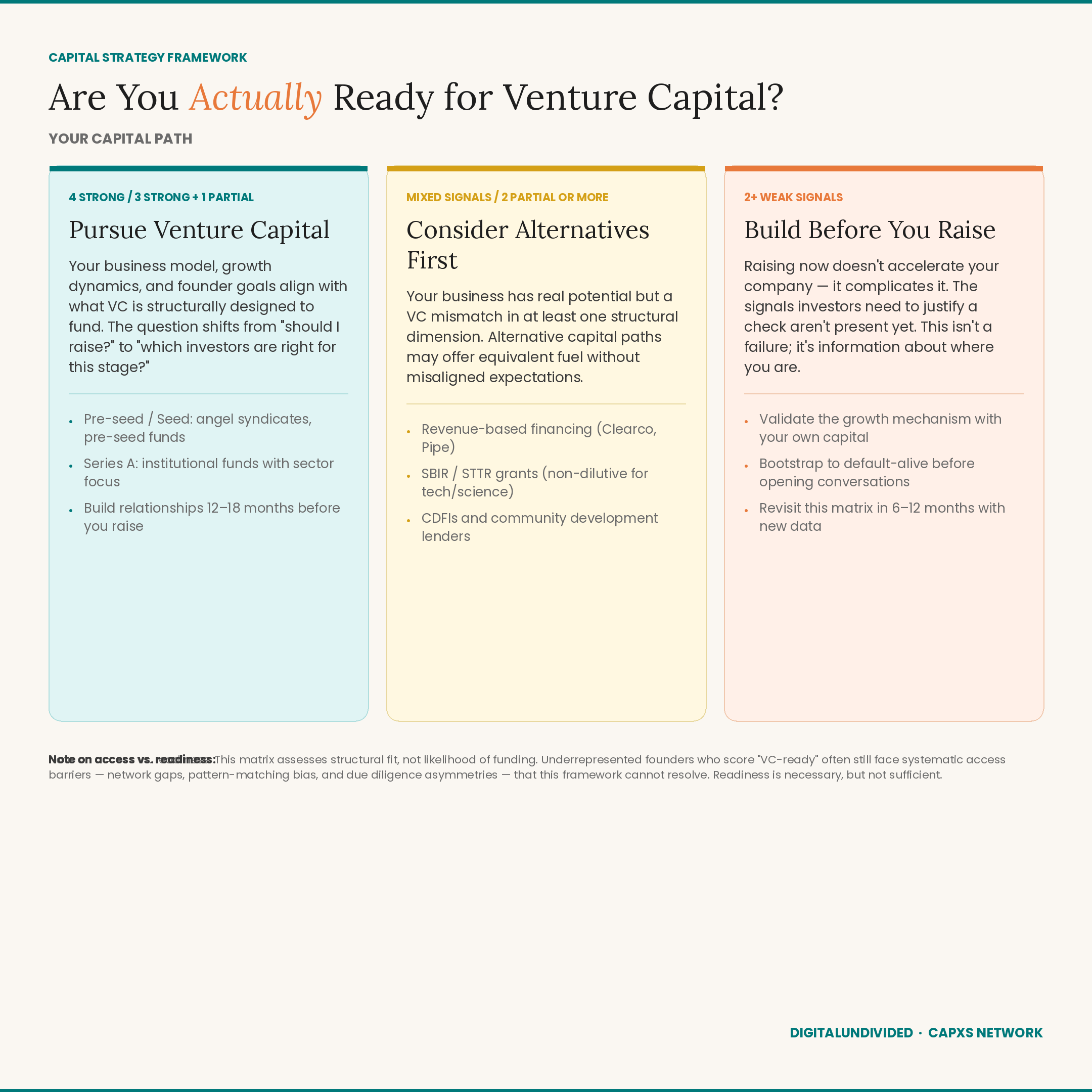
If you answered "no" or "I'm not sure" to more than two of these, you are not necessarily building the wrong company. You may simply be at the wrong stage for venture capital, or building a company that is better served by a different capital instrument entirely.
Understanding stages in practice
The funding landscape is often discussed as a clean ladder. In practice, the stages are messier, but the expectations at each level are real, and jumping stages prematurely is one of the most common and costly mistakes founders make.
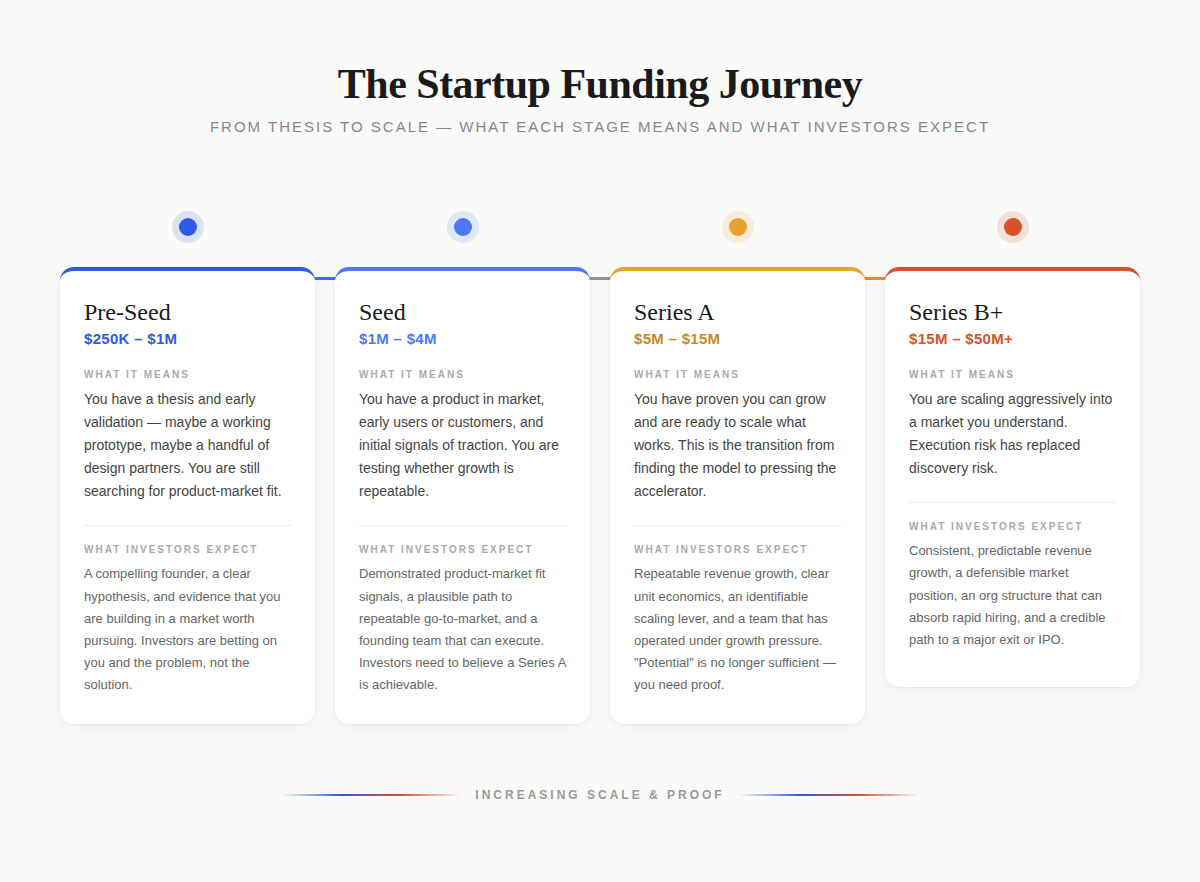
The most common stage mismatch: founders with seed-stage evidence pitching for Series A capital. Andreessen Horowitz has written extensively about this gap: the difference between early traction (growth happened) and Series A readiness (you know why growth happened and can make it happen again). Most founders who struggle to raise a Series A have the same underlying issue: they optimized for the pitch before building the underlying repeatability the stage requires.
When VC is not the right move yet
The Kauffman Foundation's research on entrepreneurship has long documented that the majority of high-growth companies were built without institutional venture capital. Studies have also found that bootstrapped companies tend to reach profitability earlier and sustain it longer, even if their total valuations remain lower. That is an empirical one.
But here is what matters for the audience reading this on a digitalundivided platform: for many Black and Latina women founders, alternative capital paths are often a strategic response to a structurally constrained VC landscape.
Project Diane's data makes the scale of that constraint concrete. From 2012–2014, less than 0.2% of all venture deals went to Black women founders, a figure so small it approached statistical insignificance. By 2018–2019, Black and Latina women combined received just 0.64% of total venture capital investment. The number of Black and Latina women founders who had raised $1M or more grew from fewer than 12 in 2016 to over 350 by 2022, real progress, but progress measured against a baseline that was functionally zero.
This means a founder can be VC-ready by every metric described in this article (the right market, the right traction, the right unit economics) and still face systematic underfunding due to pattern matching, network effects, and implicit bias that Project Diane has documented across multiple cycles. VC-readiness and VC-access are not the same experience for every founder, and any honest treatment of this subject has to acknowledge that gap.
Which is precisely why understanding alternative capital is a strategic competency.
Revenue-first growth means your customers validate your business before any investor does. It forces discipline, preserves ownership, and builds a track record that makes you a stronger candidate if and when you do pursue institutional capital.
Grants and non-dilutive funding, including SBIR/STTR grants, foundation funding, and accelerator programs that offer capital without equity, allow founders to de-risk their businesses without giving up ownership at the stage when their equity is cheapest.
Revenue-based financial provides growth capital tied to your actual revenue, not to projected valuations and exit timelines. For founders in markets with strong unit economics but moderate growth curves, this can be a better structural fit than equity-based VC.
Community Development Financial Institutions (CDFIs) offer lending and investment specifically designed for underserved communities and founders who may not fit the profile that traditional capital sources pattern-match against.
None of these paths are inferior to venture capital. They are different instruments, designed for different conditions. The question is not which path sounds best in a pitch. It is which path fits your actual business, your market, your ownership goals, and where you are right now.
The real question
The question is not "Can I raise?" Most founders with a strong deck and the right introductions can get a meeting. The real question is: should I raise right now? And if so, for what specific purpose, at what cost, with what expectations attached?
Raising capital you are not ready to deploy effectively does not accelerate your company. Sometimes, it complicates it. It adds investor expectations to a business that may have needed more time. It introduces board dynamics before you have the operational maturity to manage them. It creates growth pressure that can push a founder to hire ahead of product-market fit, expand into markets before the core is defensible, or optimize for metrics that impress investors rather than metrics that build a durable company.
And for founders navigating a capital ecosystem that already offers fewer at-bats, the cost of a premature raise is dilution or misaligned expectations, but also it is the opportunity cost of a second chance that may not come.
A note on the next step
The venture capital ecosystem rewards a very specific kind of company at a very specific moment, and it is structurally indifferent to every other kind, no matter how good the business is. The founders who make the best capital decisions are not the ones who raise the most money. They are the ones who understand, clearly and early, whether the instrument matches the company they are actually building, and who have the discipline to choose a different path when it does not.
For Black and Latina women founders, that clarity is a competitive advantage in a system that was not designed with you in mind, and one of the most powerful things you can bring to any capital conversation, whether it happens at a VC firm, a grant program, or across your own P&L.
Capital strategy is no less rigorous than product strategy, and founders who treat it as an afterthought consistently pay for it, whether in unnecessary dilution, misaligned investor expectations, or growth pressure the business isn't ready to absorb. The CapXS Network was built specifically to address that gap: a structured resource for founders working through capital decisions before (not during) an active raise.
References: digitalundivided, Project Diane 2016, 2018, 2020, 2022 (projectdiane.com); National Venture Capital Association (NVCA) fund return data; Brad Feld and Jason Mendelson, Venture Deals: Be Smarter Than Your Lawyer and Venture Capitalist; Andreessen Horowitz, "Series A readiness" framework; Kauffman Foundation, Growth Entrepreneurship Index and entrepreneurship research; Eric Ries, The Lean Startup; Y Combinator founder resources.